October 2024
Andrew Ziminski is a stonemason and the author of two books about British buildings. He’ll be talking about the second of those, Church Going, at Bridport Arts Centre on Thursday 7 November at 10am (BridLit Event 23).
We caught up with Andrew ahead of his illustrated talk to discover more about his fascinating career and his love of ancient churches…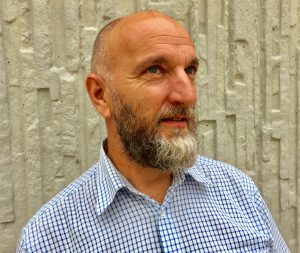
The Bridge: How did you become a stonemason, Andrew? How (if at all) did your formal education prepare you for this career?
Andrew Ziminski: My father was a stonemason in Scotland for a while after the war, working to build the stone outflows for hydroelectric power schemes. I liked the permanency of his work, which he said would last “for a thousand years”. I always wanted to be an archaeologist but was not particularly academic and the school I went to was only good for creating numbskulls. In my teens I got hooked by the idea of a career repairing old buildings during a visit to a local open-air museum in Sussex where they were rebuilding a medieval merchant’s house from my hometown using only authentic materials and methods. I volunteered at the museum and then went on to train at Weymouth College and Salisbury Cathedral, and 40 years later still very much enjoy my work.
TB: Do you have a faith? Do you feel ‘closer to God’ in a church?
AZ: I guess I’ve become an ‘agnostic Anglican’. My Polish father despised the church after what he saw and experienced of it at home. So, I’ve made my own way on my ‘faith journey’, which has been enhanced now and again by how the atmosphere that a particular church may hold can fuse with some other unexplained agency to bend the doubts of this particular faith fence-sitter. For example, one early morning at St Mary’s, Steeple Ashton, Wiltshire, when it was still dark, I could sense that it was not just the High Gothic architecture that made the place feel revered. Dawn was strengthening to warm the east window, which filtered a mist of soft golden sunlight into the chancel; I felt the essence of something unknown loosening from its walls, like the warmth of a night storage heater. In some way, this fused the synaptic with the momentary to fill that small space between my head and heart. I didn’t feel that the building’s architecture, art or sculpture could explain the effect; it had perhaps more to do with the embodied emotion and devotion left by many generations of parishioners.
TB: Many of our readers are Christian churchgoers, but we also reach people of other faiths, and of none. How would you encourage even resolute atheists to go into our churches and look around?
AZ: Churches are many things to us all – even the staunchest atheist will understand that they are places of worship, vibrant community hubs and oases of calm reflection. They will also understand that to know a church is to hold a key to the past that unlocks an understanding of our shared history. In my work and travels, I’ve been careful not to forget that churches are holy places for Christians who come to them to worship or have their own private conversation with God. But for many others, churches have become sacred in a new way. They often find the interior moves them beyond religion and want little more than the reassuring presence of a hard old bench to sit on and a quiet atmosphere to take in.
TB: What’s your favourite church in the UK?
AZ: Am I allowed two? Ranworth, in Norfolk, where you can climb the tower (which is open every day) and enjoy the best view across the Broads and then come down the spiral stairwell to enjoy its painted rood screen, which is one of the great artworks of northern Europe. Branscombe in Devon always gets to me, too. It’s an accumulation of the ages in a dramatic setting at the head of a wooded combe that leads down to the sea. Oh, and Sherborne Abbey.
TB: And do you have a favourite among your many projects as a stonemason?
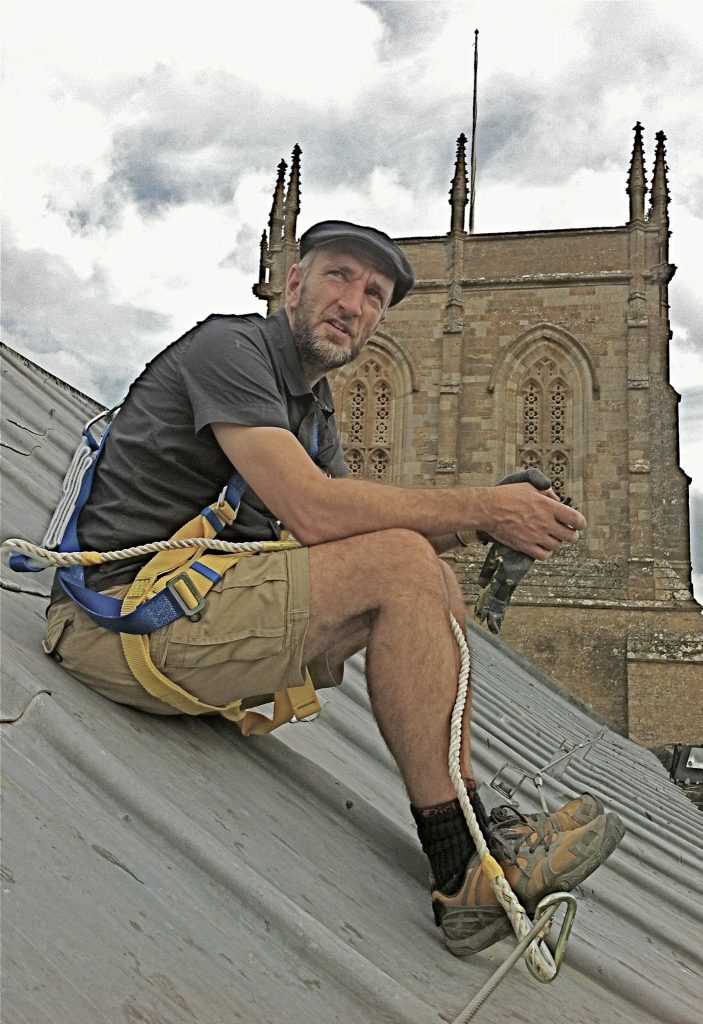 AZ: My favourite church project was for the Churches Conservation Trust at St Mary’s Hemington, Somerset, where during Covid we repaired the roof timbers and covered it with new lead, fixed the crumbling tower stonework, lime-plastered the interior and mended the monuments.
My other favourite project was not on a church but the Barton Farm bridge in Bradford-on-Avon, Wiltshire. It was built in the 1320s. We had to take much of it apart and discovered that the stones were glued together with clay! It was wonderful to enjoy the river’s wildlife as we worked, from the giant trout that sheltered beneath our pontoon to the bats that lived in the bridge and the kingfishers that perched on our scaffolding.
TB: Many English churches, particularly in villages, are sparsely attended and expensive to maintain. Do you think all historic churches are worth preserving?
AZ: It’s impossible to consider what will come of our churches without reading Philip Larkin’s Church Going. Even though the poem was published nearly 70 years ago, it addresses those questions of church attendance and what will become of what will be a community’s most important building. He wonders:
“When churches fall completely out of use
What we shall turn them into, if we shall keep
A few cathedrals chronically on show,
Their parchment, plate, and pyx in locked cases,
And let the rest rent-free to rain and sheep.
Shall we avoid them as unlucky places?”
I guess that people will always be drawn to old churches, as Larkin optimistically muses:
“Someone will forever be surprising
A hunger in himself to be more serious,
And gravitating with it to this ground,
Which, he once heard, was proper to grow wise in…”
Clearly it will become impossible to keep all churches maintained, repaired and open. As ever it’s a question of funding: some are just not suitable for alternative use and their dereliction may be too far advanced, and that – allied with a community’s lack of desire or energy to keep a church open – may mean perhaps sale and conversion to dwellings for local people would often be the best solution.
But the vast majority of churches I visit are still managed by volunteers and churchwardens who still possess that energy, and the churches’ deep roots within the community and the memories they preserve make them ideal community centres.
The chancel’s sacred area must be kept for worship or private prayer but why not use the rest of the space for community use for mother and toddler groups, concerts, coffee mornings and theatrical and art events. There is nothing sacrilegious in this as this division between the people’s part of the church, the nave and the sacred space of the chancel was very clear up to Victorian times. To survive, churches must become more than ‘places of worship’ and keep the doors open to the secular neighbourhood.
TB: Church Going is your second book. Can you tell us a bit about your writing process? After four decades perfecting the practical craft of stonemasonry, how does writing make you feel?
AZ: I’ve taken to the writing process surprisingly easily. It’s not dissimilar to the craft of stonemasonry; instead of having to create something from a blank block of stone, it is an empty page you stare at, and you just have to stay at it until you have a finished section of church moulding or a written chapter. It’s all about editing until it is right. In both crafts you have to be able to visualise what’s hidden within, what the stone or the page may reveal. I’m surprised more craftspeople haven’t made the transition.
Tickets for Andrew’s talk are £13 from www.bridlit.com.