November 2024
A name on the Walditch war memorial is associated with the first Victoria Cross (VC) awarded in World War II – and what is more, this happened partly on the recommendation of the captain of a German warship. Robin Stapleton tells the story…
William Fletcher was a petty officer stoker on the 1,340-ton HMS Glowworm, a destroyer, when it was caught up in an action in the North Sea during the ill-fated Norway campaign, April to June 1940. Glowworm was part of an escort for HMS Renown (a battlecruiser), protecting a mine-laying operation to deter the Germans from landing troops, when it was diverted to look for a man overboard.
On its return, the ship encountered two German destroyers. Glowworm engaged, landing a hit on one of them, and both the destroyers quickly withdrew because they were transporting troops to be landed at Trondheim and needed to avoid getting into a battle.
Glowworm had no radar and in chasing after the destroyers was drawn into a trap from which there was no escape when it sighted the Admiral Hipper (14,000 tons), a vastly superior and speedier ship. Glowworm made smoke to mask its movement, but Admiral Hipper had a modern gun-control system that allowed it to land several hits on the British ship, including to the engine room where William was working. He didn’t really have a chance of surviving such a direct hit.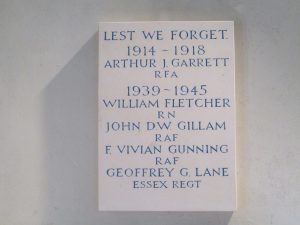
Admiral Hipper was ‘bows on’, making it a small target; Glowworm fired 10 torpedoes that went close, although none was a hit. By now Glowworm was badly damaged, on fire and doomed, but even so, a salvo from its three remaining guns secured a hit before it rammed the German ship, damaging its hull. After pulling back, Glowworm began listing and its boilers exploded. At this point, Lieutenant Commander Gerard Roope (born in Taunton) ordered ‘abandon ship’ and Glowworm shortly afterwards rolled over and sank.
Despite the rough, cold sea, 40 out of Glowworm’s crew of 149 were rescued by the Germans, although only 31 eventually survived. Roope made sure that all those who could be rescued were helped before he attempted to climb a rope to board the Admiral Hipper. Sadly by now he was cold, tired, weak and unable to hold on; eventually slipping down, he was lost to the sea.
Even though he knew a signal had been sent off giving his position, Captain Heye – commander of the Admiral Hipper – hung around for an hour taking a risk. He was so impressed with Roope’s outstanding courage that he later made a recommendation for a VC to the Admiralty via the British Red Cross. Lt Cdr Roope was posthumously awarded the first VC of WWII. It was not gazetted until 6 July 1945 in a supplement to the London Gazette, with the award backdated. King George VI presented the medal to Roope’s widow at Buckingham Palace on 12 February 1956.
William Fletcher is named on the Walditch memorial and, along with all those who did not survive, on the Royal Navy War Memorial on Southsea Common, overlooking the Solent.
German troops were subsequently landed at Trondheim. Afterwards the Admiral Hipper returned to harbour for repairs and was out of action for a time. In 1945 it was damaged by the RAF and later scuttled by its crew, raised and sold for scrap.