May 2026
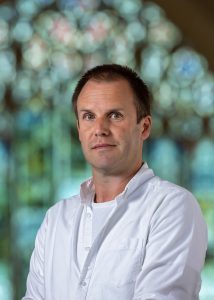
Musician Matt Kingston – also known by his professional name, Matthew Coleridge – was involved with Bridport choirs long before he became a leading light in the world of contemporary choral composition.
His new album, The Breath of Life, was released a few weeks ago and two local choirs will be performing its major work in a concert this month under Matt’s direction.
We caught up with Matt at his home on the Denhay Estate near Bridport…
The Bridge: Matt, congratulations on your new album! You’re becoming a familiar name in musical circles and your Requiem appears in Classic FM’s Hall of Fame again this year. How did you get started in composition?
Matt Kingston: I didn’t come through the traditional route for professional musicians of a degree course, training at a conservatoire, or through the cathedral system. My parents weren’t musical, although my grandparents on my mum’s side were, and my professional name comes from my grandfather, Eric Coleridge, who was a composer, violinist, organist and music teacher. My parents encouraged me and my siblings to play music – we all played instruments, it was part of normal life. I took up the trumpet and the piano when I was about seven, and started singing in a church choir near home in Cheltenham.
I wrote a few pieces when I was young, then in my 20s I got into popular music and worked as an arranger. In my early 30s I moved to West Dorset, and met my wife, Ellen, when she was selling Denhay cheese at the farmers’ market in Bridport. She sang in the Broadoak Choir, so I joined too; they sang (and still sing) a lot of music composed by Chris Reynolds, their musical director at the time, and this encouraged me to give it another go.
TB: So how did your Requiem come into being?
MK: Our first child, Sebastian, was born in 2014 and I suddenly felt strongly that I wanted to start composing more seriously. The Requiem started to come together very quickly, and I set myself a deadline by booking St Mary’s Church in Bridport for the first performance in October 2015. That concert was a huge success, and people started asking for a recording of the work – there wasn’t one, so I started crowdfunding to get a professional choir to record it.
I’ve also raised money by leading ‘come and sing’ workshops where we rehearse the Requiem for a day and finish with a performance. I think I must have conducted it over 40 times now, and it’s always a privilege to do so.
TB: So you raised enough money for the professional recording?
MK: Yes – I recorded it in 2016 with a group called RSVP Voices with just an organ for accompaniment, and then again in 2023, sung by the Choir of Royal Holloway with the Southern Sinfonia chamber orchestra. Classic FM made it their album of the week, which certainly helped its success.
TB: So how does your new album, The Breath of Life, differ? Have you felt your composition style evolving?
MK: The Requiem is explicitly Christian and uses a traditional, fixed series of Latin texts. Breath of Life is more varied – some of the texts are Christian, but others are more general, touching on ‘the divine’. I started by setting a psalm and a hymn, then stumbled across other texts that expressed a different spirituality and which I found very powerful.
I’ve set words by the 18th-century English poet Christopher Smart; Nikos Kazantzakis and Rabindranath Tagore; Kahlil Gibran, Albert Einstein and John Muir. Moving away from the traditional Anglican doctrine means the music speaks to more people, which can make it more meaningful. And people with no experience of choral music can relate to it.
The order of movements is largely determined by pacing – after a big energetic peak, the next movement is still, soft and gentle, drawing listeners into stillness so they can think about the beauty of the words.
As well as the main cantata on The Breath of Life, the album also includes Songs of Light, three pieces using words by Rumi, Tagore and Muir. Another local choir, Cantamus, sang these at their spring concerts recently.
TB: And now ‘your’ choir is performing The Breath of Life right here in Bridport…
MK: Yes! I’ve been the musical director of the West Dorset Singers since 2011 (they were called the New Elizabethan Singers until three years ago) and they agreed to sing The Breath of Life before it was even finished. For the concert we’re joined by the Broadoak Choir and we’ve paired my work with Aldhelm’s Bridge by Chris Reynolds; they make a good contrast and complement each other well. The programme has a blend of Christian and spiritual messages, with an appreciation of the natural world, too.
TB: Who are your musical influences?
MK: Sometimes I have to ignore outside influence, to try and be myself when I’m composing. I often find myself straying towards the ‘colour palette’ that American composers such as Eric Whitacre and Morten Lauridsen use, and I have to steer myself away and make my own path. I love Benjamin Britten’s music and the way he structures it; his use of rhythm in his vocal and choral music is extraordinary. I’ve learnt mostly by osmosis, by absorbing musical ideas from British composers of the 20th century, a lot of early and medieval music, right through to bands such as Pink Floyd, Queen and Radiohead, but always turning the music into something that sounds like my voice.
TB: You and Ellen now have two children. Are they musical?
MK: Sebastian is 12 now and he’ll be singing alto in The Breath of Life at our concert this month. His sister Bea, who’s 10, plays the violin and writes music. They both appreciate all kinds of music – they get it!
The concert by the West Dorset Singers and the Broadoak Choir is at 7pm on Saturday 16 May at Bridport United Church.
www.matthewcoleridge.com